I studied microbiology. In class we spent long hours on bacteria, algae and early forms of life. When I think about the ocean off Nilaveli, that training still shapes how I look at a reef day — not as a show, but as a web of living parts.
This post is a short awareness note on marine ecosystems: what holds them up, what changes with depth, and why coastal habitats matter here. It is not a textbook and not a booking pitch.
Come as a guest. Leave as a friend.
| Question | Short answer |
| What is a marine ecosystem? | Water, organisms and conditions working together as one system |
| What sits at the base of the food chain? | Tiny plant-like plankton (phytoplankton) using sunlight |
| Why do reefs and mangroves matter? | Shelter, nursery space, coast protection |
| Biggest pressures today? | Heat stress, pollution, overfishing, habitat damage |
The starting point you cannot see
Most people picture fish or coral first. The foundation is smaller.
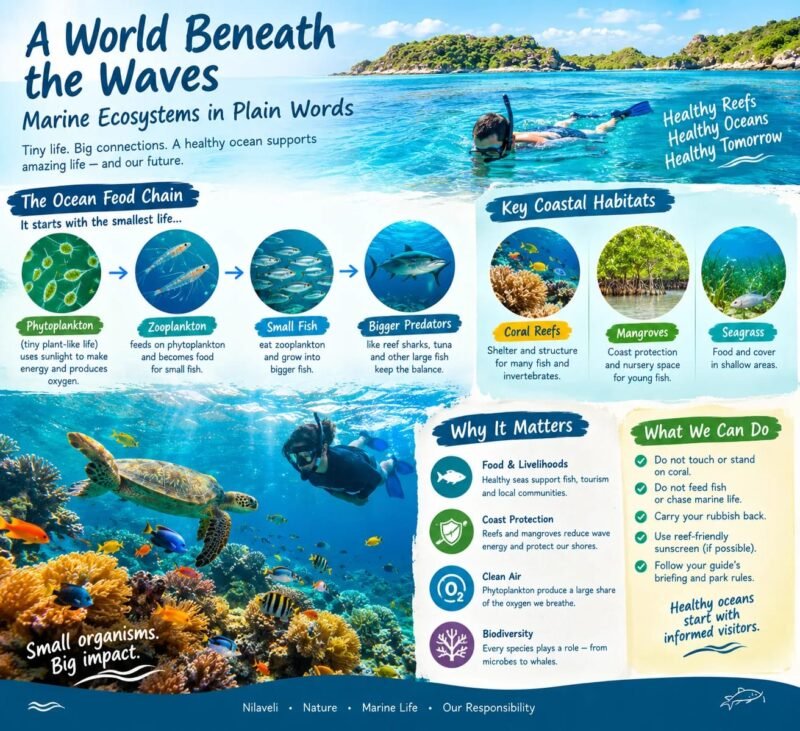
Phytoplankton — microscopic algae — use sunlight to make energy. Much of the rest of ocean life depends on that base, directly or through the food chain. They also produce a large share of the oxygen in the air we breathe. From a microbiology desk that fact is a line in a book. On a boat morning it is a reason to treat “empty blue water” with more respect.
The ocean changes as you go deeper
Near the surface there is light and relative warmth. Deeper, light fades, cold increases, pressure rises. Different organisms are built for different zones.
In the deep ocean, far from our east-coast trips, some communities live around hydrothermal vents where sunlight never arrives. Certain microbes use chemical energy instead of light. That detail is not something we visit from Nilaveli — it simply shows how many ways life finds to continue when conditions look impossible from the beach.
Quiet work of coastal habitats
Closer to home, three habitats do heavy work:
- Coral reefs — structure and shelter for many fish and invertebrates
- Mangroves — coast protection and nursery space for young fish
- Seagrass — food and cover in shallow areas
When guests snorkel a protected reef day at Pigeon Island, they are inside one of those systems — a living structure, not a swimming pool decoration. Touching coral, standing on it, or leaving plastic behind is not a small “oops.” It hits the same web that makes the place worth the boat ride.
Related reading: [What To Do (and Not Do) In the Water] · [Pigeon Island National Park: Protection Rules Every Visitor Should Know] · [Why I Care About Pigeon Island: A Microbiologist’s View]
Pressures we already see in conversation
Rising heat and changing chemistry stress coral. Plastic reaches places it never belonged. Overfishing removes the grazers and predators that keep balance. None of this is only a problem “somewhere else.” It shows up in visibility, in fish behaviour, and in how careful we must be on every trip.
Awareness does not mean guilt on holiday. It means knowing the difference between looking and harming.
A final thought from this coast
The smallest organisms help hold up the largest systems. Whales and reef sharks get the camera time. Microbes and plankton keep the engine running.
If you come to Nilaveli for the water, take the memory and the photograph. Leave the reef as you found it. Ask us when you are unsure about gear, timing or what is allowed in the park. Clear rules and calm swimming protect the same place you came to enjoy.
Come as a guest. Leave as a friend.
Frequently Asked Questions
The linked system of seawater, living organisms and physical-chemical conditions that support life in the sea.
They form the base of many ocean food chains and produce a large share of Earth’s oxygen through photosynthesis.
No — but it helps explain why no-touch rules and park limits exist.
Do not stand on or touch coral, do not feed fish, carry rubbish back, and follow the guide’s briefing.
Explore our Nilaveli base →
Pigeon Island snorkeling →
Angel Rock snorkeling →
More from our content hub:
Pigeon Island Guides & Memories —
Angel Rock & Local Snorkeling —
Whale & Dolphin Stories —
Fishing Experiences —
Marine Conservation & Reef Protection —
Lagoon Nature & Practical Guides —
Local Stories & Trincomalee History —
Taste of Nilaveli —
Sas — Snorkeling In Nilaveli Islands, Nilaveli, Trincomalee.
Awareness only. Protect what you came to see.


