Dolphin watching Nilaveli from local guide is an early open-sea morning, not a show. You leave the coast while the light is still soft, look for movement on the surface, and hope the animals are feeding or travelling where the boat can watch without pressure.
I am Sas. I organise sea days from Nilaveli. I often join the boat with guests. I also take my own family when the sea allows. The first fins on the water still change the mood on board — adults go quiet, children point, cameras come up too fast. Those moments are real. They are not something I can sell as a fixed schedule.
This guide is for visitors who want more than a short brochure. It covers the marine setting around Trincomalee Bay, the dolphin species most often discussed on this coast, simple science in plain language, season and conditions, responsible behaviour, and how a morning trip usually unfolds. It supports our dolphin-focused and open-sea work. It is not a second price list.
Come as a guest. Leave as a friend.
Nilaveli, Trincomalee Bay, and the water under the map
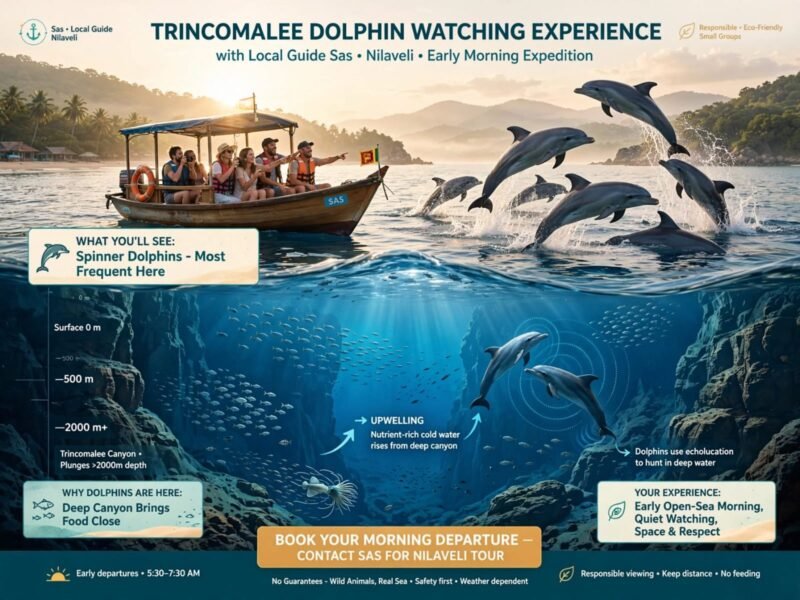
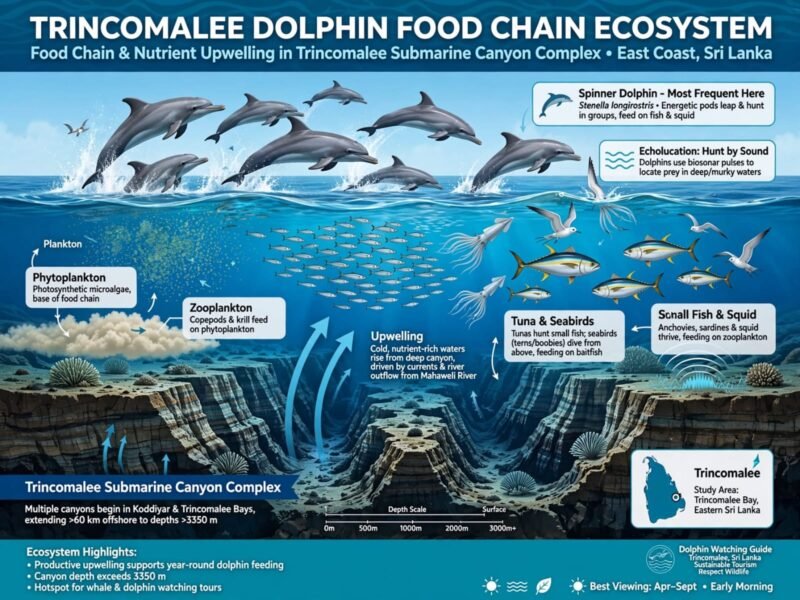
Nilaveli sits on Sri Lanka’s east coast, north of Trincomalee harbour. Offshore, the seabed does not stay shallow for long. Trincomalee is known for a multiple submarine canyon complex — deep structure close to land compared with many other whale- and dolphin-watching coasts.
Deep relief can move cooler, nutrient-richer water into zones where light and food webs meet. That kind of system can support plankton, small fish, squid and the animals that hunt them. Guests do not need a lecture on bathymetry. They need one clear idea: productive water can sit within a practical morning run from this coast when the sea is workable.
That is geography. It is not a promise that dolphins will appear beside the boat on your date.
Scientific boat work in Trincomalee Bay and adjacent waters has documented a wide set of cetaceans. A multi-month survey published in 2014 Nanayakkara, Herath and de Mel recorded encounters on most field days and identified eleven cetacean species in the study area — including blue whale, Bryde’s whale, sperm whale, and several dolphin species.
In that work, spinner dolphins were the most frequently observed cetacean, including large pods and regular sightings across the sampling months. They were also the only species the team reported feeding or travelling in association with birds and tuna. Bottlenose and striped dolphins were among the other delphinids noted, alongside rarer toothed whales.
I share this because guests deserve a grounded picture. Research describes what has been recorded in the area. It does not write your morning’s script. Pod size, distance and behaviour still change with food, boats and weather.
Dolphin species guests ask about
Spinner dolphin (Stenella longirostris)
The species most often linked to lively surface behaviour on this coast. Named for spinning leaps. Pods can be large. Early hours are when feeding and travel activity is often easiest to notice from a small boat.
Bottlenose dolphin (Tursiops truncatus)
Familiar to many travellers from films and aquariums — in the wild they are simply wild. Social, sometimes curious about boats, sometimes completely uninterested.
Striped dolphin (Stenella coeruleoalba)
Recorded in regional surveys; less often the main “show” species guests describe after a short harbour-side morning.
Other cetaceans — including large whales — use the same broader system of deep water and food. A dolphin-focused morning stays nearer the dolphin search. A whale-focused morning may continue farther when conditions and the agreed plan allow. They are related products, not identical ones.
How dolphins live in the water — simple science
Echolocation
Toothed dolphins send rapid clicks and read the returning echoes. In practical terms: they can hunt and navigate when our eyes are almost useless. That is one reason a quiet sea and patient watching matter more than shouting for a jump.
Social groups
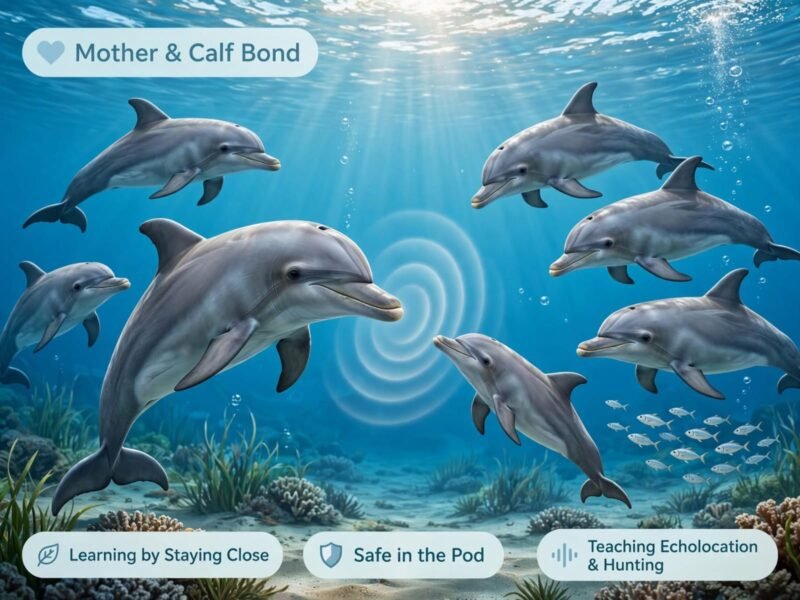
Dolphins live in fluid groups. Mothers and calves, feeding clusters, travel lines — the structure you see from a boat is only a slice of a longer day underwater.
Food webs
Where small fish and squid gather, predators gather. Seabirds working the surface can be a useful clue for crews. Spinner dolphins in the Trincomalee study were noted with birds and tuna — a reminder that the “dolphin moment” sits inside a wider feeding system, not in isolation.
I am a microbiology graduate by training. I care about living systems, not only photographs. On the boat I still speak in ordinary words: follow the water, give animals space, do not turn a feeding group into a traffic jam.
Best time and conditions for dolphin watching in Nilaveli
On the east coast, many operators treat roughly May to September as the stronger window for workable open-sea mornings — calmer patterns are more common than in the heavier monsoon months on this shore. Within that window, days still differ. Wind, swell and visibility can close a plan even in a “good” month.
2026 peak season — dolphin availability month by month
Use this table as a practical seasonal guide, not a sighting forecast. Dolphin activity can change with weather, sea conditions, food and location, and sightings are never guaranteed.
| Period 2026 | Dolphin chance | Local note |
| May 2026 | Strong | Workable open-sea mornings begin |
| June 2026 | Strong (peak) | Spinner pods more often seen |
| July 2026 | Strong (peak) | Calm seas · good surface light |
| August 2026 | Strong (peak) | Still peak · afternoon wind some days |
| September 2026 (my own experience-even october also we saw sperm whale and dolphins togather hunting small fish group) | Strong in 2026 | Many mornings with dolphins (and sometimes whales) — still not guaranteed every trip |
*The September note reflects the 2026 seasonal observation you supplied. Publish it as a local observation rather than a verified forecast unless you have current sighting records to support it. Confirm sea conditions close to the trip date.
We prefer early departures. Light is softer, the sea is often kinder, and there is usually less boat pressure than later in the morning. Exact meeting times are confirmed when you book.
If your Sri Lanka dates fall in the opposite monsoon pattern, other coasts may suit dolphin watching better. Match the coast to the season — do not force the wrong sea.
What a morning trip is really like
- Meet early from the Nilaveli area.
- Run out into open water and search.
- If dolphins are found, watch with distance and sense.
- Enjoy the wider sea and coastal light even when the surface is quiet.
- Return according to conditions and the agreed plan.
Dolphin-focused time is generally shorter than a deep-sea whale search that continues farther offshore. Confirm duration when you book.
What we will do
- Try
- Explain
- Put safety and animal space before a forced close approach
On busy mornings several boats can gather on the same group. That is uncomfortable for animals and for guests. We prefer space over a crowded circle of engines.
My local notes — family, crowding, and clear water
Dolphin watching is more than a photograph for me. I have taken family out when the sea allowed. The excitement when the first fins appear is the same whether the guest is a child or a parent.
In peak periods, crowding is a real issue. Too many boats on one pod helps nobody. Responsible viewing means leaving animals a path and accepting that sometimes the best choice is to ease off and look elsewhere.
On some clear mornings, when dolphins stay near the surface and the water is clean, guests see a lot from the boat alone. That is enough. We do not need to turn every encounter into a chase.
Choosing a responsible operator
Ask simple questions:
- Following crew instructions
- Not demanding closer and closer approaches
- Choosing operators who will postpone when the sea is wrong
- Treating the morning as a visit into someone else’s home, not a private show
Protecting the food web that supports dolphins also supports the fishing families who share this coast.
Frequently Asked Questions
No. Sightings are never guaranteed.
No. A dolphin-focused morning emphasises the dolphin search and is usually shorter. A whale-focused trip places more time on a deeper or longer search. Dolphins may still appear on a whale morning.
Early morning. Confirm the exact time when booking.
Shorter than a full deep-sea whale run. Confirm for your date.
Often yes, with honest assessment of sea comfort and early starts. Tell us ages when you enquire.
Safety first. We may postpone or cancel.
WhatsApp with date, number of guests, and whether you want a shorter dolphin focus or a longer whale search. We confirm conditions and the right plan.
Closing
Dolphin watching Nilaveli from local guide sits on real water, real animals and real limits. The canyon system and seasonal food help explain why cetaceans use this coast. Research has recorded spinner dolphins as especially frequent in systematic surveys. None of that writes a guarantee on your ticket.
We go out early. We look. We give space. We tell you what the morning actually held.
Come as a guest. Leave as a friend.
Explore our Nilaveli base →
Whale and dolphin watching tour →
Pigeon Island snorkeling →
More from our content hub:
Pigeon Island Guides & Memories —
Angel Rock & Local Snorkeling —
Whale & Dolphin Stories —
Fishing Experiences —
Marine Conservation & Reef Protection —
Lagoon Nature & Practical Guides —
Local Stories & Trincomalee History —
Taste of Nilaveli —
Sas — Snorkeling In Nilaveli Islands, Nilaveli, Trincomalee.
Educational guide. Wildlife is not guaranteed. Confirm sea conditions before you book.


