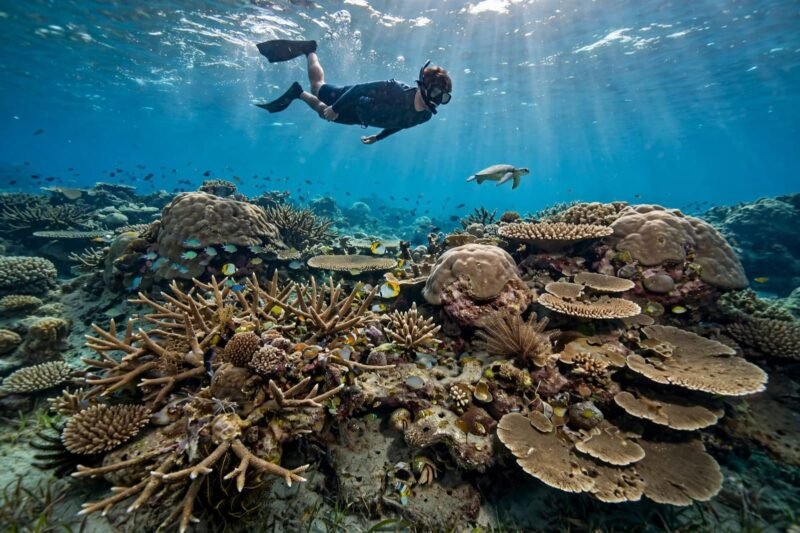
When guests put their face in the water at Pigeon Island, the first question is often about fish or turtles. The second, if someone is looking carefully, is about the hard shapes under them: branching plates, rounded heads, soft leather-like forms.
I am Sas. I organise trips from Nilaveli and studied microbiology, so I notice structure as well as colour. This note is a plain guide to coral types at Pigeon Island that literature and field time both point to — not a scientific inventory of every colony, and not a guarantee of what any one morning will show.
Sea conditions, visibility and reef condition change. Storms, heat stress and recovery leave mixed patches. Treat this as orientation, not a checklist to tick off.
Come as a guest. Leave as a friend.
Why a “list” is never complete
Published notes for this coast often speak of on the order of 100 coral species in the wider Trincomalee area, with many of those found inside the national park. A full species-by-species tourist list is not something we invent for marketing. What is useful for a snorkeler is the main groups you are likely to recognise when the water is clear enough.
This post sits with our marine conservation notes. The booking page for the trip explains time, gear and practical details. Here we stay with what the reef is made of.
Hard corals you may recognise
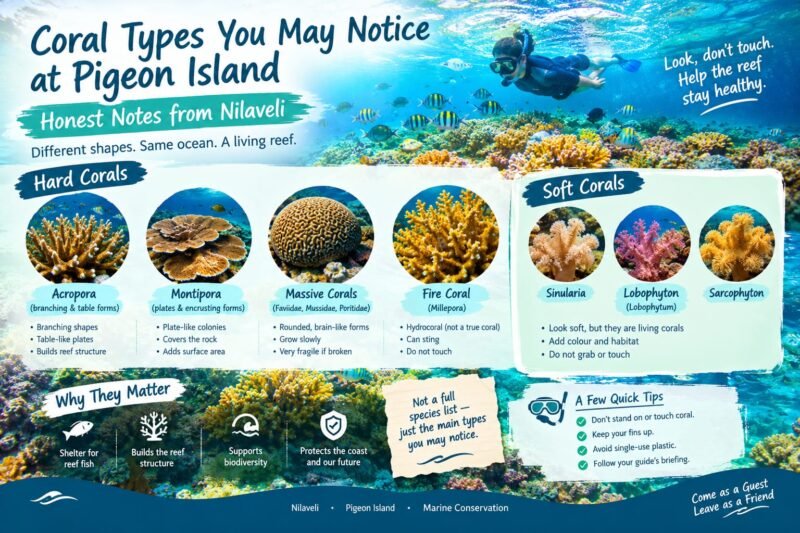
Acropora — branching and table forms
On the main shallow reef in front of the larger island, Acropora is frequently described as dominant. You may see:
- Branching shapes (often called staghorn-type in plain language)
- Flatter table or plate-like colonies spreading sideways
These corals build a lot of the three-dimensional structure that smaller fish use for shelter. They are also sensitive to physical damage and to prolonged warm water. Looking is fine. Standing or resting fins on them is not.
Montipora — plates and encrusting forms
Montipora is often mentioned together with Acropora on this reef. Colonies can form plates or grow more tightly over the rock. Beside branching Acropora, these plates change the texture of the bottom and add another layer of living surface.
Massive and brain-type groups
Around rocky sections and islets, literature points to families such as:
- Sinularia
- Lobophyton / Lobophytum
- Sarcophyton
are reported in areas of the park. They do not build the same rigid limestone framework as hard corals, but they are part of the living cover. Again: look, do not grab.
What this means on a normal snorkeling morning
Time in the water is limited. A useful habit is:
- Notice branching or table structure (often Acropora-type) on the main reef flat.
- Notice plates and encrusting surfaces (often Montipora-type).
- Notice rounded massive heads on rockier ground.
- Leave soft and hard colonies untouched.
If visibility is poor, or if the day is rough, the same types are still there — you simply see less of them. We do not invent a perfect coral garden for every date.
A separate note on our site covers what a healthy reef looks like in practical signs (living texture, grazing fish, rubble versus structure). This article is only about types. Together they support understanding without replacing the tour page.
Pressures that change what you see
Live coral cover on this reef has been reported at very different levels in different survey years. Heat, crown-of-thorns outbreaks in the past, physical damage from careless use, and waste all leave marks. Recovery is uneven. Some patches look strong; some look mixed or broken.
That honesty belongs in any useful coral note. Guests who expect a postcard every minute are more disappointed than guests who understand they are visiting a working, stressed, still valuable system.
FAQ
Literature often cites around 100 coral species for the wider Trincomalee area, with many found in the park. We do not publish a fake complete name list for marketing.
Acropora (branching and table), Montipora, massive groups such as Faviidae, Mussidae and Poritidae, plus soft corals such as Sinularia, Lobophyton and Sarcophyton.
No. Conditions, depth, and chance decide what is obvious on any morning.
No. Touching and standing damage living tissue and structure. Follow the guide and park rules.
Millepora can sting. Do not handle reef structures you cannot identify.
No. Trip timing, gear and booking are on the Pigeon Island snorkeling tour page. This is an awareness note only.
Explore more from our Nilaveli base →
https://nilaveliislands.com/
Pigeon Island snorkeling trip details →
https://nilaveliislands.com/pigeon-island-snorkeling-tour/
Angel Rock snorkeling →
https://nilaveliislands.com/angel-rock-snorkeling/
More local guides and stories from our content hub:
- Pigeon Island Guides & Memories — https://nilaveliislands.com/category/pigeon-island-guides-memories/
- Angel Rock & Local Snorkeling — https://nilaveliislands.com/category/angel-rock-local-snorkeling/
- Whale & Dolphin Stories — https://nilaveliislands.com/category/whale-dolphin-stories/
- Fishing Experiences — https://nilaveliislands.com/category/fishing-experiences/
- Marine Conservation & Reef Protection — https://nilaveliislands.com/category/marine-conservation-reef-protection/
- Lagoon Nature & Practical Guides — https://nilaveliislands.com/category/lagoon-nature-practical-guides/
- Local Stories & Trincomalee History — https://nilaveliislands.com/category/local-stories-trincomalee-history/
- Taste of Nilaveli — https://nilaveliislands.com/category/taste_of_nilaveli_blogs/
Notes from Sas — Snorkeling in Nilaveli Islands, Nilaveli, Trincomalee.
Awareness only. No wildlife or coral-condition guarantees.