The history of whale watching in Trincomalee is not only a tourism story. It is the story of a deep coastline, seasonal food in the water, and people who worked this sea long before anyone sold a “whale ticket.”
I am Sas. I organise early boat mornings from the Nilaveli side of this coast. Guests often ask why whales appear here at all — and why boats do not always need hours of travel to reach deeper water. This post is that background: local memory, geography, and honest limits. It supports our open-sea days. It is not a second sales page.
Come as a guest. Leave as a friend.
Before tours — fishermen already knew the giants
Long before organised whale watching, fishermen from Nilaveli and nearby villages met large animals on the way to offshore grounds. Those meetings were part of work, not a product.
Stories passed between crews: a tall blow on the horizon, a dark back rolling, a fluke lifting before a long dive. People did not need a brochure to know that something big used these waters.
When east-coast tourism grew, researchers and travellers paid more attention. The same coastline that fed fishing families became a place where visitors hoped to see blue whales and sperm whales. Local operators — including those of us based in Nilaveli — began running dedicated early mornings for guests who wanted that open-sea search.
The animals did not arrive because of tourism. Tourism arrived because the animals were already part of this coast’s living pattern.
The water under the map — Trincomalee’s deep canyon
One reason this coast matters sits below the surface.
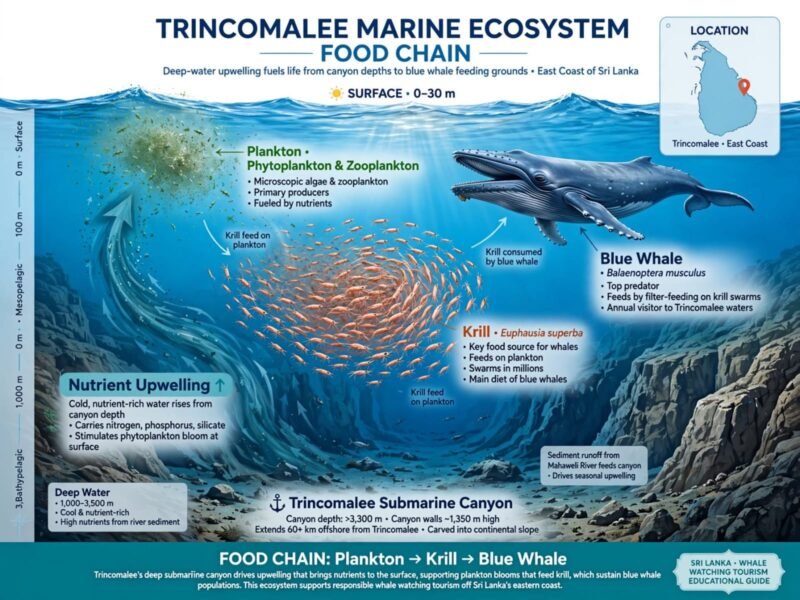
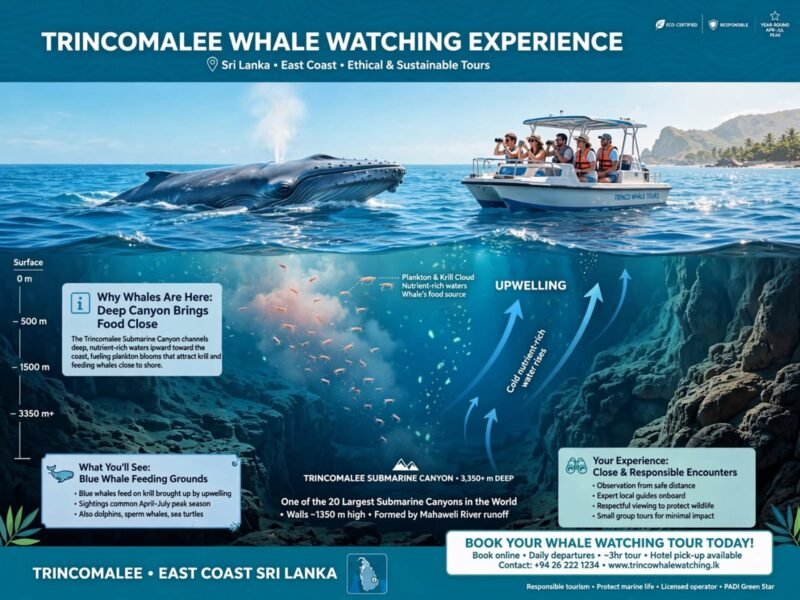
Not far from the Nilaveli–Trincomalee shore lies deep submarine relief often described as the Trincomalee submarine canyon — a steep drop into much deeper Indian Ocean water. Deep structure can bring cooler, nutrient-richer water into zones where light and food chains meet. That kind of system can support plankton, small schooling fish, squid and the predators that follow them.
I do not lecture guests with textbook depth numbers on the boat. I do explain simply: here, productive water is not always a half-day steam offshore. On many mornings we can be in searching water relatively soon after leaving the coast — if the sea allows the plan.
That geography is practical, not poetic. Shorter runs can mean more time looking, and less time only travelling. It does not mean whales will surface on demand.
Why whales can appear relatively close to shore
In some whale destinations, boats travel a long time before the water is deep enough to matter. Trincomalee’s east-coast shelf edge is different in character: depth and feeding opportunity can sit closer to land than visitors expect.
That is an advantage for a morning trip — when conditions are right. It is still the ocean. Wind, swell, visibility and the animals’ own movement decide the day.
Blue whales and sperm whales — two different stories
Blue whales
The largest animals known. On this coast, guests hope for them especially in the stronger east-coast months. They feed mainly on small swarming food such as krill-type prey. A blow and a long back can stop a boat conversation in one second. I have shared mornings with guests when a blue whale appeared near the Trincomalee harbour side of our work — including memories from seasons such as August. Those days stay with people. They are not a promise for the next booking.
Sperm whales
A different animal. They dive deep for squid and use deep water as hunting ground. The canyon and offshore deep water suit that behaviour. Sometimes guests see a group at the surface before a long dive; sometimes only a single fluke. Sperm whales have featured in local fishing and open-sea stories on this coast for a long time — including stories I have shared from people who work these waters year after year.
Dolphins
Spinner and bottlenose groups are often part of the same early hours — closer in, or along the way — before a boat continues farther for a whale search. Dolphins can be frequent in a good season window and still absent on a quiet morning.
Wild means possible, not booked.
East-coast season in plain language
For planning from Nilaveli, the east-coast window many operators work with runs roughly March through September, when this side of the island is often calmer than the heaviest monsoon months.
A simple working sketch (not a guarantee calendar):
| Period | Practical note |
| March | Season opening — conditions improve; sightings can still be uneven |
| April | Building — more stable talk of whales and regular dolphin mornings |
| May | Calmer pattern often begins — stronger planning month for many guests |
| June-August | Peak planning window for many whale-focused mornings — still day-by-day |
| September | Season easing — operators often wind down regular whale emphasis |
| Oct-Feb | East coast often rougher or less workable for this product — many guests look to other coasts or other activities |
Sri Lanka’s monsoon shift also moves attention around the island across the year. South-coast windows and east-coast windows are different seasons for many travellers. That is geography and weather — not a competition slogan.
For month-by-month trip planning language we already published a practical season guide for Nilaveli mornings — use that when you choose dates.
Trincomalee and other Sri Lankan whale areas
Guests sometimes ask only: “Mirissa or Trincomalee?”
Honest answer: different seasons, different boat traffic patterns, different travel times offshore.
East-coast mornings from Nilaveli can mean shorter runs to searching water and, in season, often fewer boats than the busiest south-coast days. South-coast season sits mainly in other months. Neither coast “owns” the whales. The animals move with food and conditions.
If your Sri Lanka dates fall in the east-coast window, Trincomalee–Nilaveli is the practical side to plan from. If your dates fall in the south-coast window, plan there instead. Do not force the wrong monsoon onto the wrong shore.
More than one morning on this coast
A whale morning is one product. The same coast also holds:
- Shorter dolphin-focused time when that is all you want
- Pigeon Island reef time inside the national park
- Angel Rock as a shorter local snorkel
- Land hours around Swami Rock, harbour views and Trincomalee history
Some guests want only the open-sea search. Some combine a careful sea morning with reef or town time on another day. We help match energy and dates — not stack every product into one exhausted schedule.
Responsible watching
Whales need space. So do dolphins.
We do not chase. We do not box animals with several boats if we can avoid it. We follow sense and local practice: approach with care, leave them a path, prioritise safety for guests and respect for wildlife. A good morning is one where people go home safe and the sea is not treated like a stage.
What this history means for your trip
The history of whale watching in Trincomalee starts with fishermen, deep water close to shore, and food chains that still draw large animals in season. Tourism layered on top of that. It did not invent the canyon or the whales.
When you book an early boat with us from Nilaveli:
We search
We explain what the day may hold
We do not guarantee a blue whale, a sperm whale, or a dolphin pod
We guarantee honest information about the sea and careful practice on the water.
Come as a guest. Leave as a friend.
Frequently Asked Questions
Deep coastal structure and seasonal food in the water. The submarine canyon system helps bring productive habitat within reach of morning boats — when conditions allow.
Organised tours for visitors are newer. Local encounters at sea go back through fishing generations.
No. No responsible operator can promise that.
They are part of this coast’s deep-water story. Sightings still vary by day and season.
No. A whale-focused morning places more time and distance on the open-sea search. Dolphins may appear along the way. Confirm the plan when you book.
Many guests aim at the stronger east-coast months, often late spring through mid-summer on this shore — still always subject to the day’s sea.
Explore our Nilaveli base →
Whale and dolphin watching tour →
Pigeon Island snorkeling →
More from our content hub:
Pigeon Island Guides & Memories —
Angel Rock & Local Snorkeling —
Whale & Dolphin Stories —
Fishing Experiences —
Marine Conservation & Reef Protection —
Lagoon Nature & Practical Guides —
Local Stories & Trincomalee History —
Taste of Nilaveli —
Sas — Snorkeling In Nilaveli Islands, Nilaveli, Trincomalee.
History and geography for understanding — not a wildlife guarantee. Confirm live sea conditions before you book.


