
A few years ago a guest stood waist-deep near Nilaveli and asked a simple question: why does the sea never feel as hot as the sand, even at noon?
I gave a short answer on the spot. The question stayed with me. In microbiology class, heat capacity was only a line in a textbook. Standing in this water, explaining it to someone who wanted to understand, felt different. This post is that idea in plain words — awareness, not a long science essay.
Come as a guest. Leave as a friend.
| Question | Short answer |
| Why is the sea cooler than the sand at noon? | Water holds heat slowly; sand heats and cools fast |
| Does the ocean affect climate? | Yes — it absorbs and moves huge amounts of heat |
| Why does this matter for snorkeling? | Reefs need stable temperatures; excess heat stresses coral |
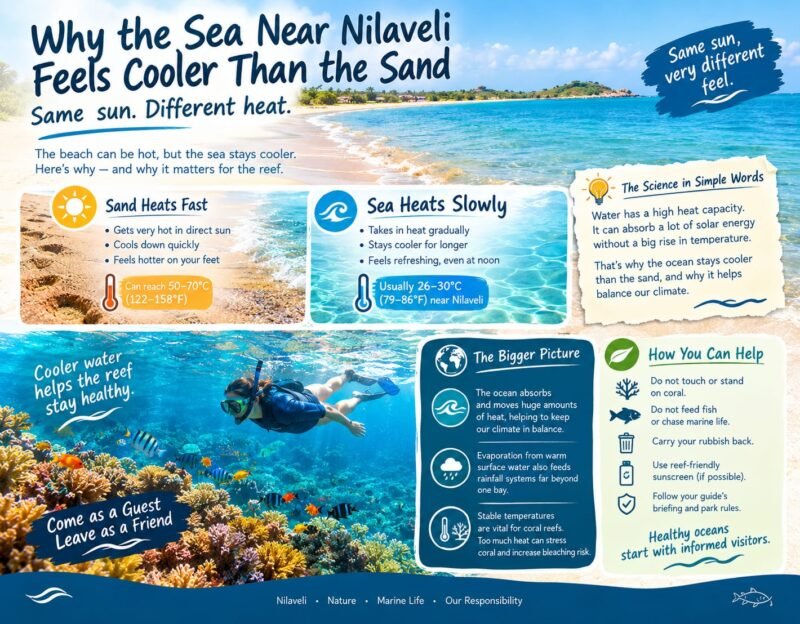
Sand vs sea — what you feel on this coast
Sand under the sun burns your feet by midday and cools again toward evening. The sea beside it stays steadier.
Water can take in a large amount of solar energy without jumping in temperature the way dry ground does. That is why a walk from the beach into the water near Nilaveli often feels like relief, even when the air is harsh. The ocean is not “always cold.” It simply changes more slowly.
On a planetary scale the same property matters. The ocean covers most of Earth’s surface and absorbs a large share of excess heat in the climate system. Without that buffer, land and air would warm faster than what we experience now. A small fraction of trapped heat stays in the atmosphere; much of the rest is held in the ocean, ice and land over time.
Heat does not sit still
Sunlight is strongest near the equator. Surface currents move warm water. Cooler, denser water can sink and travel in deep flows. The full loop of that global circulation is slow — measured in long human time, not one holiday week.
You do not need the full map to enjoy a morning on this coast. It is enough to know that the calm water under a snorkel mask is part of a larger heat story, not only a blue background for photographs.
Why reef days care about this
Coastal places like Nilaveli and Trincomalee often feel milder than deep inland heat because the nearby sea absorbs and releases energy slowly. Evaporation from warm surface water also feeds rainfall systems far beyond one bay.
For the reef, temperature range matters. Coral lives within a fairly narrow comfort zone. When ocean heat rises beyond what the animals can handle, even for a short period, stress and bleaching risk go up. That is the same reef guests come to see on a Pigeon Island day — living tissue, not decoration.
So climate talk and coral talk are not two separate subjects. They meet in the water temperature you feel on your skin.
Related reading on this coast: Protecting the Ocean: Why Conservation is Vital for Nilaveli’s Future · How We Protect These Reefs · Pigeon Island National Park: Protection Rules Every Visitor Should Know.
What I want visitors to take away
You do not need equations to respect this coast.
Notice that the sea holds its temperature differently from the sand. Notice that a healthy reef depends on conditions staying within limits. Swim without standing on coral. Leave rubbish on land. Ask honest questions about the day before you book.
Awareness is not a slogan. It is paying attention while you are here.
Come as a guest. Leave as a friend.
Frequently Asked Questions
No. It simply changes temperature more slowly than sand or shallow rock in full sun.
Excess heat can stress coral. Local reefs are part of that wider pattern; day-to-day conditions still vary.
No — a short local note so guests understand what they feel in the water.
Explore our Nilaveli base →
Pigeon Island snorkeling →
Angel Rock snorkeling →
More from our content hub:
Pigeon Island Guides & Memories —
Angel Rock & Local Snorkeling —
Whale & Dolphin Stories —
Fishing Experiences —
Marine Conservation & Reef Protection —
Lagoon Nature & Practical Guides —
Local Stories & Trincomalee History —
Taste of Nilaveli —
Sas — Snorkeling In Nilaveli Islands, Nilaveli, Trincomalee.
Awareness note. Not a full climate paper.


