Whale and dolphin mornings from Nilaveli in 2026 were not a single postcard day. They were a season — especially September — when the open water off Trincomalee harbour kept giving us work worth waking for.
I am Sas. I go out with guests on these early runs. What follows is not a promise that every future morning will look the same. It is what we actually saw and did in this season, written so visitors who plan an open-sea morning understand what the day can hold beyond a single word: “whale.”
September on this stretch of coast
In the 2026 season, and particularly in September, we saw dolphins on a great many mornings. Whales appeared often enough that the month felt rich — not because anyone can book a guaranteed sighting, but because the water was busy.
Around Trincomalee harbour, early access matters. The sea is quieter before the day fills with boats. That is one practical reason we favour a very early start.
Food chain, not a fixed viewing spot
Most operators gather in familiar places and wait. On several mornings we moved on alone.
Away from the cluster, we found something clearer: three or four sperm whales working around a tight group of small fish — mathi. Dolphins stayed in the same system, accompanying the movement. It was not a show arranged for the boat. It was a food chain visible on the surface and just below it: small fish, larger hunters, and the mammals that work that edge.
When guests ask what makes a morning memorable, I often come back to this. Whale and dolphin mornings from Nilaveli are stronger when you understand you are watching feeding behaviour, not a fixed stage.
A cloudy, rainy start — and dolphins still playing
One morning we left under cloud, with a little rain still in the air. The dolphins were restless in the best way — long runs, leaps, the kind of energy that makes a quiet boat feel lucky.
Baby dolphins stayed close to the mothers. Guests with children pointed and watched; the adults did too. Clear water helped. When dolphins came in beside the boat, you could see them swimming fully, not only as dark shapes on the surface. They are curious. They are funny. They decide the distance — we do not force it.
What else moves in the harbour
The same season showed more than whales and dolphins.
Local fishermen worked trap lines for small tuna. Others fished bait from kayaks over deeper water. When I asked about the season, the answer was consistent: many kinds of fish groups moving across the east coast, and around Trincomalee harbour in particular.
Flying fish crossed the open stretches on multiple trips. Guests who came only for “whale watching” often remembered those silver flashes as clearly as the larger animals. An open-sea morning from Nilaveli is a harbour and ocean day — not a single species ticket.
Why we start around 5:30
We often leave near 5:30 am.
The reason is simple: fewer boats, calmer first light, and a better chance to watch without a crowd line. Sunrise comes on slowly. The mind settles. Guests who accept the early alarm usually say the quiet was part of the value — not only the animals.
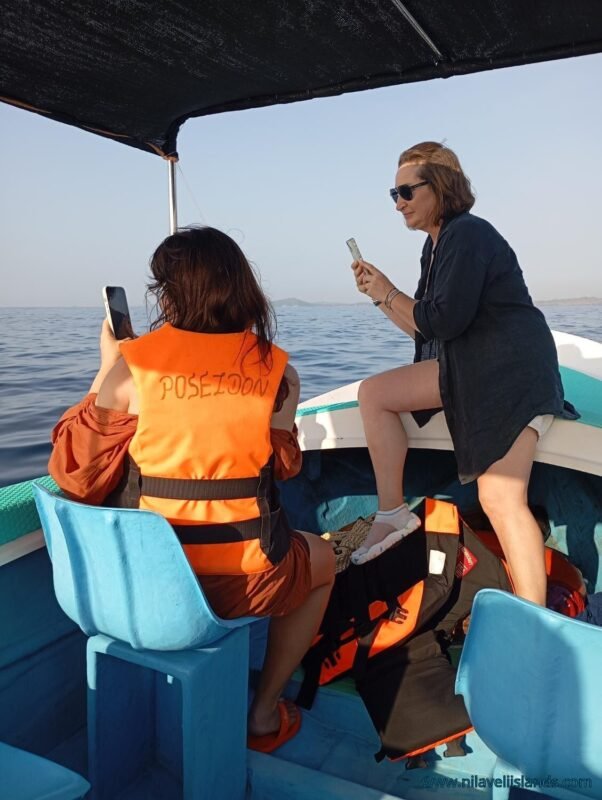
Some peak-season days bring harder wind. The ride gets wetter; spray comes up when the boat moves to keep contact with a whale. That does not happen every day. When it does, soft clothes, sunglasses and a towel are more useful than fashion. This is ordinary advice from the boat, not a warning designed to scare anyone off.
After the open water — Swami Rock from the sea
I go out with guests most days in season. I explain what we are seeing when I can, and I ask what they want to know. The trip is not a silent transfer.
After time with dolphins and whales, the boat usually comes in near Swami Rock — the view from the water, not a long land tour. From that angle guests can take photographs of the rock and the temple shoreline. We stop for a short refreshment: water and fresh fruit are part of the trip. Then we return to the same starting point.
If the group is interested, I speak briefly about the names that sit on this coast — Koneswaram (Swami Rock), Ravana’s Cleft and Lover’s Leap. Trincomalee is not only sea adventure and seafood. It holds historical stories of water and land together. Guests who want that short context get it; guests who prefer to head straight back after the animals still get the ocean-view stop, the photos, the water and fruit, and a calm run home.
That sequence is included in how we run the morning: open sea → Swami Rock from the ocean → refreshment → start point.
What I want visitors to know before they book
Whale and dolphin mornings from Nilaveli in 2026 taught the same lesson we already tell honestly:
- Dolphins are frequent in a good season.
- Whales — including sperm whales — appear on some days and not on others.
- A solo run away from the main cluster can reveal feeding behaviour you will not see in a tight boat group.
- Harbour life, flying fish, light and early quiet are part of the day.
- Swami Rock from the ocean, photos, water and fruit, then return to the start — included in the run.
- Short history (Koneswaram, Ravana’s Cleft, Lover’s Leap) when guests want it — not forced. Trincomalee is sea, food and land stories together.
We do not sell a guaranteed mammal list. We sell a well-timed morning on this coast, with clear talk before the engine starts.
Come as a guest. Leave as a friend — including to the animals that set their own distance.
Frequently Asked Questions
Dolphins were very regular. Whales were frequent in that stretch of the season. “Almost every day” describes a strong month, not a permanent rule for every future September.
Small fish that gather in groups. When sperm whales and dolphins work that edge, you are watching a food chain, not a random surface visit.
Fewer boats, better first light, more room to watch without crowding.
No. Some windy peak days are wetter and harder. Soft clothes, sunglasses and a towel are sensible. Most mornings are manageable.
Yes — from the water after the open-sea time. Guests can photograph the rock, take water and fruit, then return to the starting point. The short history (Koneswaram, Ravana’s Cleft, Lover’s Leap) is explained when guests want it; it is not forced.
No. We can promise an early, organised morning and honest reporting of what the sea gives that day.
Explore our Nilaveli base →
Whale & dolphin watching tour page →
Fishing mornings on this coast →
More from our content hub:
Pigeon Island Guides & Memories —
Angel Rock & Local Snorkeling —
Whale & Dolphin Stories —
Fishing Experiences —
Marine Conservation & Reef Protection —
Lagoon Nature & Practical Guides —
Local Stories & Trincomalee History —
Taste of Nilaveli —


Pingback: Best Time for Whale and Dolphin Watching in Nilaveli | Season Guide